
By Frank Mwaala Sipilanyambe
Founder, CEO & Principal Consultant
Quacha Advisors
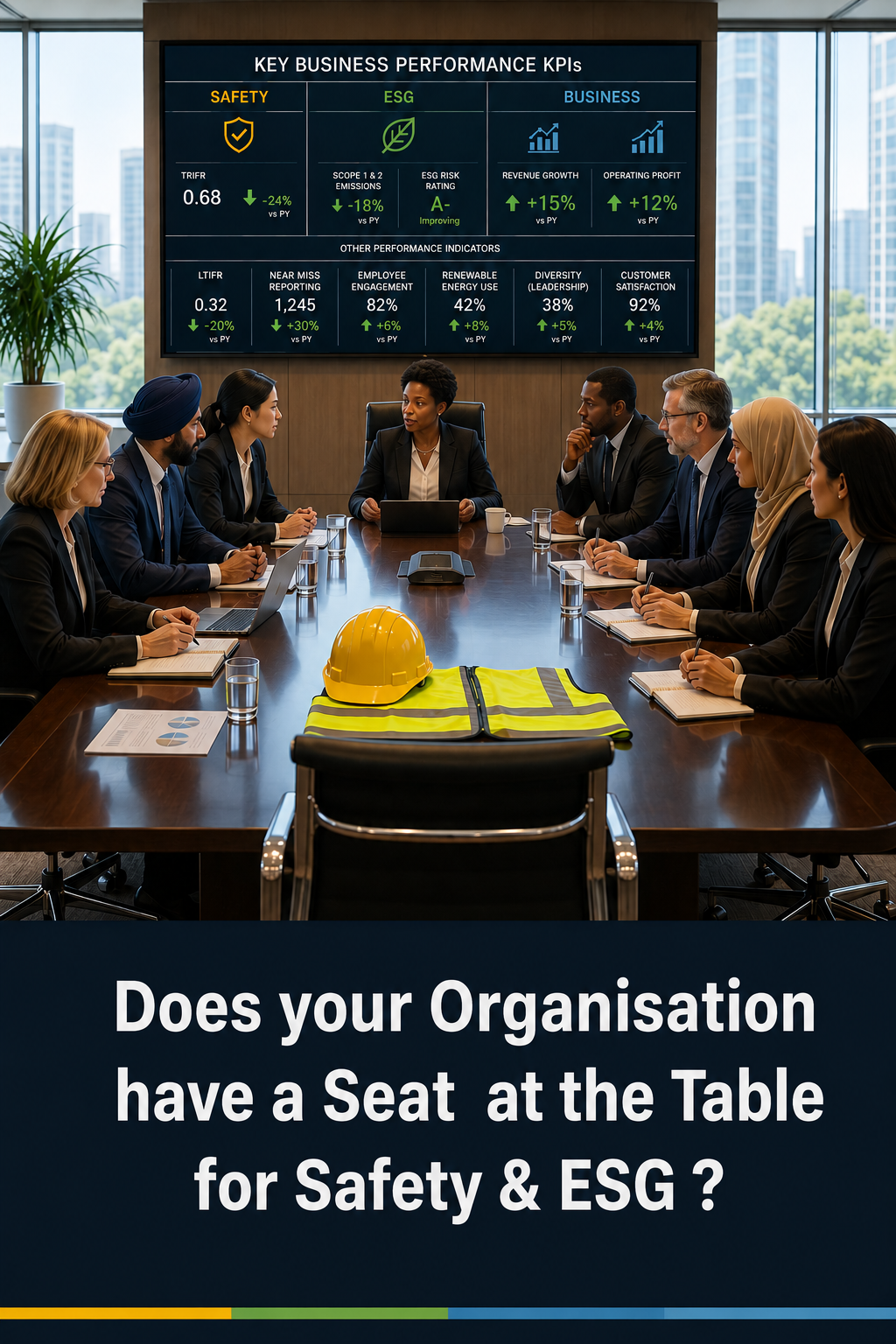
Walk into most executive boardrooms and you will find seats occupied by leaders responsible for Finance, Operations, Human Resources, Commercial, Legal, Technology and Strategy. Yet one critical voice is often absent.
Safety and ESG.
Ironically, these are the very disciplines capable of preventing catastrophic incidents, protecting corporate reputation, ensuring regulatory compliance, improving operational performance and creating sustainable long term value.
The question every Board and Executive Leadership Team should ask is simple.
Does your organisation have a seat at the table for Safety and ESG?
The Business Environment Has Changed
For decades, organisations viewed workplace safety as a compliance obligation and environmental management as a regulatory requirement. Today, the expectations of investors, regulators, customers, employees and communities have fundamentally changed.
Safety and ESG have evolved into strategic business functions.
Executive teams are now expected to manage enterprise risk, organisational culture, climate related risks, workforce wellbeing, sustainability performance, governance, supply chain resilience and stakeholder trust.
These responsibilities cannot simply be delegated to operational teams. They require executive leadership.
International Standards Place Responsibility on Top Management
The world's leading ISO management systems all recognise that organisational success begins with leadership.
ISO 45001 Occupational Health and Safety Management Systems requires top management to demonstrate leadership, accountability, worker participation and integration of safety into business processes.
ISO 14001 Environmental Management Systems requires executives to establish environmental policy, allocate resources and drive continual improvement.
ISO 9001 Quality Management Systems makes leadership responsible for organisational direction, customer focus and performance improvement.
ISO 31000 Risk Management recognises that effective risk management must be embedded within governance, strategy and decision making.
ISO 26000 Social Responsibility encourages organisations to integrate ethical behaviour, stakeholder engagement and sustainable development into leadership practices.
Collectively these internationally recognised standards reinforce one simple message.
Leadership drives performance.
Without executive ownership, management systems rarely achieve their full potential.
Investors Are Looking Beyond Financial Performance
Capital markets are changing rapidly.
Institutional investors increasingly evaluate organisations on governance maturity, sustainability performance and risk management capability.
Global reporting frameworks such as the International Sustainability Standards Board IFRS S1 and IFRS S2, the Global Reporting Initiative Standards, and the Task Force on Climate Related Financial Disclosures expect organisations to demonstrate robust governance arrangements, board oversight and executive accountability for sustainability related risks and opportunities.
In many jurisdictions, directors are expected to understand how environmental, social and governance issues may materially affect organisational performance.
Safety performance is equally recognised as an indicator of operational excellence, organisational culture and governance effectiveness.
Safety and ESG Are Business Performance Indicators
High performing organisations no longer separate safety from business performance.
They understand that serious incidents, fatalities, environmental events, psychosocial harm, cybersecurity failures, supply chain disruptions and governance failures all affect profitability.
Strong Safety and ESG leadership contributes to:
• Better operational performance
• Reduced workplace injuries and fatalities
• Lower regulatory exposure
• Stronger workforce engagement
• Improved contractor performance
• Enhanced organisational resilience
• Better environmental outcomes
• Increased investor confidence
• Stronger corporate reputation
• Greater long term shareholder value
These outcomes are not achieved through compliance alone.
They are achieved through leadership.
Why Safety and ESG Belong at the Executive Table
Every strategic business decision carries risk.
Whether approving a major capital investment, entering a new market, acquiring another business, introducing new technology or responding to climate related challenges, Safety and ESG considerations should form part of executive decision making from the outset.
When Safety and ESG leaders participate in Executive Leadership Teams and Executive Committees they provide valuable insight into enterprise risk, regulatory obligations, organisational culture, operational resilience and sustainable value creation.
Rather than slowing business decisions, they strengthen them.
The most progressive organisations recognise Safety and ESG as competitive advantages rather than compliance costs.
The Cost of Leaving the Seat Empty
History has repeatedly demonstrated the consequences of weak executive oversight.
Major industrial disasters, environmental pollution events, governance failures, psychosocial harm, contractor fatalities and reputational crises have resulted in billions of dollars in losses and, more importantly, the loss of human lives.
In almost every case, post incident investigations identify failures in governance, leadership, risk management or organisational culture.
Rarely do organisations fail because they lacked procedures.
They fail because critical risks were not adequately represented at the executive table.
The Future of Corporate Leadership
As organisations continue adopting Artificial Intelligence, digital transformation, ESG reporting obligations, climate adaptation strategies and integrated management systems, executive leadership must evolve.
Tomorrow's leading organisations will integrate Safety, Sustainability, Governance and Risk into every strategic conversation.
Safety and ESG should no longer report from the sidelines.
They deserve a permanent seat at the executive table.
How Quacha Advisors Can Help
At Quacha Advisors, we partner with Boards, Executive Leadership Teams and Senior Management to transform Safety and ESG from operational functions into strategic business enablers.
Our executive advisory services include:
• Board and Executive Safety and ESG Strategy
• ESG Strategy Development and Roadmaps
• Executive Safety Leadership Coaching
• Board Governance and Assurance
• Enterprise Risk Management
• Critical Risk Management Frameworks
• Integrated Management System Strategy
• ISO 45001, ISO 14001 and ISO 9001 Executive Readiness
• ESG Materiality Assessments
• Sustainability Strategy and Reporting
• Executive Performance Dashboards and KPIs
• Safety Culture Transformation
• Executive Due Diligence Reviews
• Board and Executive Workshops
• Organisational Risk and Governance Reviews
• Health, Safety, Environment, Security and Quality Transformation Programs
• Executive Mentoring for Safety and ESG Leaders
• Strategic Planning and Facilitation
• Independent Executive Advisory Services
Our mission is simple.
To ensure every organisation has the leadership capability, governance structures and strategic direction required to build safer workplaces, stronger businesses and more sustainable futures.
Every seat at the table matters.
Make sure Safety and ESG are not the empty one.